 The Daily
Wednesday, November 18, 2026
Today's three tips
Three golf tips a day. Quick, medium and in-depth.

 Quick · 1 min Fundamentals
Slow Down Your Takeaway
Start the backswing low and slow for the first foot. A rushed takeaway throws off your rhythm for the entire swing.
 Medium · 3 min Putting
Reading Green Speed
Greens change speed through the day. Downhill and downgrain putts run faster; putts that are into the grain or uphill run slower.
 In-Depth · 10 min Short Game
Wedge Spin Explained
Spin comes from friction between the clubface and ball, so clean contact and good equipment matter.
More tips
New this month and coming up next
 Quick · 1 min Fitness
Protect Your Elbows From Golfer’s Elbow
Golfer's elbow, also called medial epicondylitis, causes pain on the inside of the elbow, where the tendons of the forearm muscles that bend your wrist and fingers attach to the bone, according to Mayo Clinic. Despite the name, anyone who grips or uses the wrist over and over can get it. For golfers, a lot of range balls, poor technique or old, heavy clubs can add up. The good news: it usually gets better with rest and simple care, and a few habits lower your risk. This is general information, not medical advice.
 Quick · 1 min Rules
Know When Your Ball Is Really Out of Bounds
Before you reload, walk up and look. Under Rule 18.2, a ball is out of bounds only when all of it is outside the boundary edge of the course. If any part of the ball touches or sits above the course side of that edge, it's in bounds and you play it as it lies. When white stakes or a fence mark the boundary, the edge is the line between the course-side points of the stakes or posts at ground level, so picture a string running along their inside edges at the bottom. The stakes themselves are out of bounds: they're boundary objects, so you can't move them and you don't get free relief from them. A painted line works the same way, and the line itself is out of bounds. You're allowed to stand out of bounds to play a ball that's still in. If the ball is fully out, the penalty is stroke and distance: add one stroke and play again from where you last hit. Some courses adopt Model Local Rule E-5, which lets you drop near where the ball went out or in the nearest fairway for two penalty strokes instead, so check the scorecard. And if you think a shot might be out, hit a provisional before you walk forward.
 Quick · 1 min Putting
Feel the Slope With Your Feet to Read Putts
Your eyes can fool you on the green, especially on long, subtle putts. Your feet are better judges of slope. The popular AimPoint green-reading method, used by tour players such as Adam Scott, Collin Morikawa, Viktor Hovland and Justin Rose, starts by feeling the tilt of the green through your feet, then turns that feel into a simple aim point. Here's the basic idea you can try on your next practice round.
 Quick · 1 min Short Game
Pick a Landing Spot for Every Chip
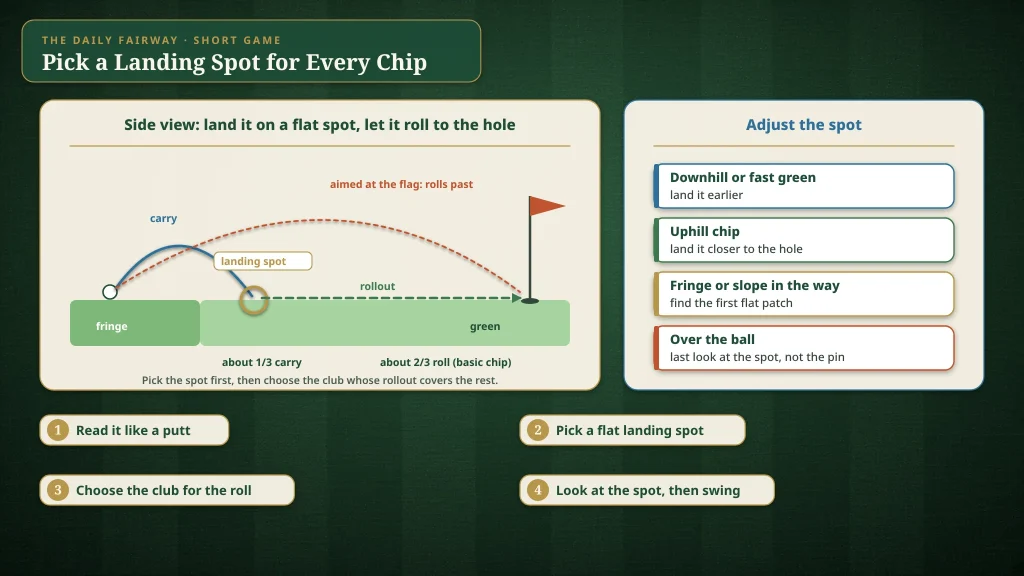
Most chips that race past the hole or come up short were aimed at the flag, not at the ground. Before you choose a club, pick the exact spot on the green where you want the ball to land, then let the club's rollout carry it the rest of the way. Choose a flat patch a few feet onto the putting surface when you can, because the fringe, a slope or the crest of a ridge makes the first bounce hard to predict. On a downhill or fast green, land it earlier; on an uphill chip, you can land it closer to the hole. Teaching pro Christina Ricci says most players pick a spot but then look at the flag as they take the club back, so the ball lands at the hole and rolls by. Two-time PGA Tour winner Gabriel Hjertstedt reads his chips like putts and even drops a leaf or towel on his landing spot in practice. A good starting point from LPGA teacher Kellie Stenzel: land a basic chip about one-third of the way to the hole. Over the ball, your last look should be the spot, not the pin.
 Quick · 1 min Putting
Make More Short Putts With the Clock Drill
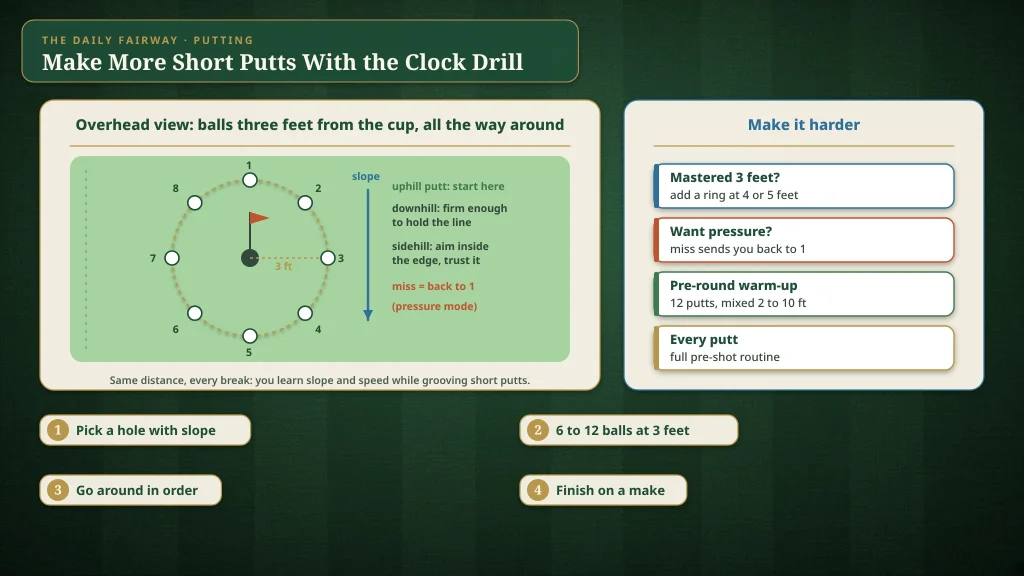
Short putts decide more scores than any other shot, and the classic clock drill is how tour players groove them. You place balls in a circle around the hole and putt them in one by one, so you face uphill, downhill and both sidehill breaks from the same distance. Here's how to set it up and make it count.
 Quick · 1 min Equipment
Build a Smarter 14-Club Bag
The Rules of Golf let you carry up to 14 clubs, but which 14 matters more than most golfers think. Many bags have two clubs that fly the same distance at the top, a gap in the wedges and a long iron that never gets hit. Golf Digest compares your bag to the 14 friends you take with you for a round: choose them carefully. Here's how to build a set that covers every yardage you actually face (written for any golfer, right- or left-handed).
Free guide: Fix Your Slice in 7 Days
A one-week plan built from our best slice tips: diagnose it, fix grip and aim, swing from the inside, then test it.